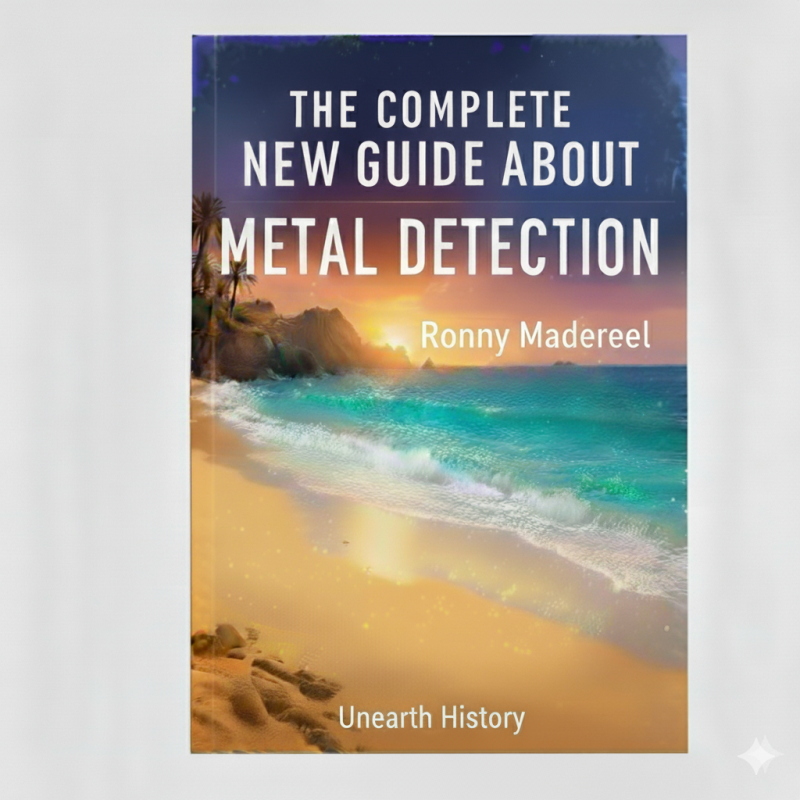
New Book about metal detection coming soon
My name is Ronny Madereel, and my passion for metal detecting began more than 40 years ago. Over those decades, I have grown from an enthusiastic amateur into a true pioneer in the Benelux region.
At the time, I launched the very first online store in Belgium that sold metal detectors. In an era when you still had to travel to the Netherlands for a purchase, I made detectors accessible via my informative site and shop, known as detectoramateur.be. I was an official distributor for leading brands such as Garrett, Whites, Tesoro, Fisher, and Bounty Hunter.
Two of these brands have not stood the test of time, as they missed the digital evolution. Tesoro was one of the my absolute favorite at the time. It was the lightest detector on the market with an incredible depth range.
At that time, I wrote comprehensive manuals for the basic operations of various detectors and meticulously documented all my findings in the field."
After years of dedication, I decided to close my store. Now, following my move to Spain, I have primarily focused on beach and river detecting for the past 15 years. Spain is rich in beaches, but it also harbors rivers where gold can be found.
Locals fiercely guard the best locations, but through perseverance, I have since discovered a few gold-bearing spots. While it won't make me rich, the find of a small piece of gold is, time and again, an exciting and unforgettable event.
I do not want all this decades-long experience and these stories to be lost. That is why I have decided to write this book. I hope you enjoy reading it as much as I have enjoyed gathering the knowledge and the writing process.
The book
Index
Part I: The Basics of Metal DetectingChapter 1: Introduction to the Hobby
* 1.1 What is Metal Detecting?
* 1.2 The History of Metal Detecting
* 1.3 The Psychology of Searching: Patience, Perseverance, and Ethics
* 1.4 What Can Be Found? (Coins, Relics, Jewelry, etc.)
Chapter 2: How the Metal Detector Works
* 2.1 The Basic Principles: Electromagnetic Induction
* 2.1.1 The Search Coil
* 2.1.2 The Control Box and Processing Unit
* 2.2 Key Technologies
* 2.2.1 VLF (Very Low Frequency): Principle and Applications
* 2.2.2 PI (Pulse Induction): Principle and Applications
* 2.2.3 Multi-Frequency Technologies
* 2.3 Ground Balance
* 2.3.1 Automatic Ground Balance
* 2.3.2 Manual Ground Balance
* 2.4 Discrimination and Conductivity
* 2.4.1 Ferromagnetic vs. Non-Ferromagnetic Metals
* 2.4.2 Target ID (VDI) Scales
Chapter 3: Choosing the Right Detector
* 3.1 Budget and Price Categories
* 3.2 Detectors for Beginners: Features and Ease of Use
* 3.3 Detectors for Advanced Users: Customization and Depth
* 3.4 Specialized Detectors
* 3.4.1 Underwater and Beach Detectors
* 3.4.2 Gold Detectors (Nugget Detecting)
* 3.5 Accessories
* 3.5.1 Different Types of Search Coils (DD, Concentric, Monoloop)
* 3.5.2 Pinpointers (The Must-Have Tool)
* 3.5.3 Headphones (Essential for Auditory Analysis)
* 3.5.4 Digging Tools (Trowels, Shovels)
Part II: Techniques, Locations, and Finding
Chapter 4: Search Strategies and Techniques
* 4.1 Field Patterns: The Grid Method vs. The Random Search
* 4.2 Interpreting Sounds and Signals
* 4.2.1 Sharp, High Tones vs. Deep, Low Tones
* 4.2.2 "Ghost Signals" and "Falsing"
* 4.3 Depth and Coil Speed: Maximizing Search Depth
* 4.4 Ground Conditions and Detection
* 4.4.1 Searching on Cultivated Land
* 4.4.2 Searching in Oxidized or Mineralized Ground
Chapter 5: Location Analysis and Research
* 5.1 Historical Research (The Key to Success)
* 5.1.1 Old Maps and Topography
* 5.1.2 Cadastral Records and Archives
* 5.1.3 Local History and Oral Tradition
* 5.2 Productive Search Locations
* 5.2.1 Lost Trails and Old Cart Tracks
* 5.2.2 Dilapidated Farms and Old Homesteads
* 5.2.3 Public Parks and Recreation Areas
* 5.2.4 Beaches and Coastlines (Using the Tide Chart)
Chapter 6: The Find and Excavation
* 6.1 Target Identification (Pinpointing)
* 6.2 Correct Digging Techniques (Minimizing Ground Damage)
* 6.2.1 The "Plug" or "Flap" Method
* 6.2.2 Determining the Correct Depth
* 6.3 What to Do After the Find
* 6.3.1 Initial Cleaning On-Site (Do Not Scrub!)
* 6.3.2 Documentation: GPS Coordinates and Photos
* 6.3.3 Filling the Hole (Always!)
Part III: Ethics, Legislation, and Conservation
Chapter 7: Legal and Ethical Aspects
* 7.1 Legislation in the Netherlands and Belgium (Detailed)
* 7.1.1 Monument and Heritage Legislation
* 7.1.2 Reporting Archaeological Finds (PAN/Local Authorities)
* 7.2 Permission and Ownership
* 7.2.1 Searching on Private Property (Treasure Trove Regulations)
* 7.2.2 Searching on Government Land
* 7.3 The Code of Conduct for the Metal Detectorist
* 7.3.1 Respect for the Land and the Owner
* 7.3.2 The Principle of "Not On It, In It, or Under It" (Leave No Trace)
Chapter 8: Find Conservation and Recognition
* 8.1 Basic Cleaning Methods
* 8.1.1 Coins: Methods for Copper, Silver, and Gold
* 8.1.2 Relics: Stabilizing Iron and Bronze
* 8.2 Conserving Finds (Long-Term Storage)
* 8.2.1 Waxing and Oiling
* 8.2.2 Electrolysis (For Advanced Iron Conservation)
* 8.3 Documentation and Cataloging
* 8.3.1 The Find Log: Date, Location, and Description
* 8.3.2 Photography of Finds (Before and After Cleaning)
Chapter 9: Community and Future
* 9.1 Metal Detecting Clubs and Associations
* 9.2 Events and Rallies (Group Searches)
* 9.3 Cooperation with Archaeologists and Museums
Appendices
* A. Glossary of Terms (VLF, PI, Target ID, Pinpointer, etc.)
* B. Contact Information for Archaeological Services
Last page: This book does not end on this last page, you are invited to join our group about metal detection.

